Rubin : The Telescope with the World’s Largest Digital Camera

Syed Armaan Ahsan
12 October 2025, 12:04
When the James Webb Space Telescope (JWST) sent back its first images, it offered humanity a glimpse deep into cosmic history — galaxies billions of light-years away, captured in extraordinary detail. Webb is a marvel of precision, a microscope into deep time.
Now, a new eye on the universe is preparing to open — the Vera C. Rubin Observatory in northern Chile. Unlike Webb, Rubin will not focus on one patch of sky. Instead, it will scan the entire southern sky every few nights for the next decade, capturing the most dynamic picture of the cosmos ever attempted.
A Telescope Built for Scale
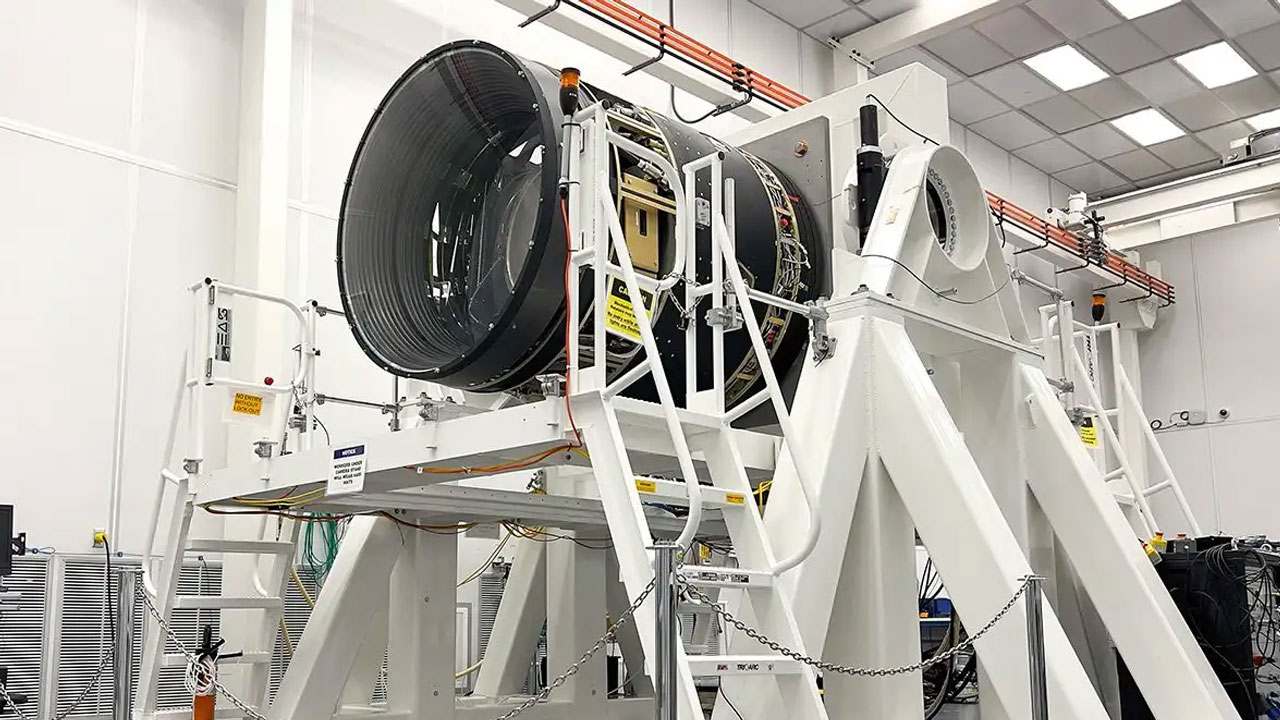
At the heart of Rubin is a combination of simplicity and power: an 8.4-metre mirror paired with a 3.2-gigapixel digital camera — the largest ever constructed. Each image covers such a wide field that 40 full moons could fit within a single frame.
Through its flagship project, the Legacy Survey of Space and Time (LSST), Rubin will generate about 20 terabytes of raw data every night — building up to tens of petabytes over its ten-year mission.
That scale pushes astronomy into new territory, where data science and machine learning become as essential as mirrors and lenses.
First Results
Rubin’s early images, released in June 2025, have already hinted at its power. In just a few nights, the observatory identified more than 2,000 new asteroids, including seven near-Earth objects. One wide-field image revealed tens of millions of galaxies in a single shot.
Where Webb peers deep into a handful of distant galaxies, Rubin will track millions of them — returning to each every few nights to record how they change.
Why It Matters
Rubin’s impact extends far beyond astronomy — into data engineering, artificial intelligence, and open science.
Big data at cosmic scale: The observatory’s nightly data flow rivals that of major social networks. Handling it demands distributed cloud storage, AI-driven analysis, and real-time pipelines capable of flagging transient cosmic events — supernovae, asteroids, or variable stars — before they vanish.
AI in the loop: With billions of galaxies in view, human astronomers can’t review everything. Rubin’s automated systems will classify objects and highlight anomalies, allowing scientists to focus on what truly matters. It’s astronomy powered by algorithms.
Open science: In a departure from traditional telescope projects, Rubin’s datasets will be publicly accessible. Researchers — and even amateur programmers — will be able to download and explore them. This openness could redefine collaboration in astronomy.
Planetary defence: Rubin’s rapid scanning also strengthens global efforts to detect and track potentially hazardous asteroids, making it a vital part of planetary protection.
Webb and Rubin: Two Eyes on the Universe
It’s tempting to compare Rubin with JWST, but they serve distinct roles. Webb focuses on depth — studying the faintest, most distant galaxies and probing exoplanet atmospheres. Rubin, in contrast, focuses on breadth and change — watching how the universe evolves night after night.
Together, they provide a complete picture:
- Webb reveals what we are seeing.
- Rubin reveals how it changes.
Looking Ahead
The biggest challenge now lies in data management. Rubin will produce millions of transient alerts every night, requiring rapid analysis to decide what deserves deeper study.
Which supernova is worth Webb’s attention? Which asteroid might drift closer to Earth? Which faint flicker signals something entirely new?
This is astronomy reborn — real-time, data-driven, and global.
If the James Webb Space Telescope stunned the world with beauty, the Rubin Observatory will overwhelm it with scale. Together, they mark a new chapter in humanity’s exploration of the cosmos — where understanding the universe depends as much on algorithms and cloud infrastructure as on mirrors and starlight.