Bangladesh makes mark at APICTA 2025 in Taiwan

15 December 2025, 10:13
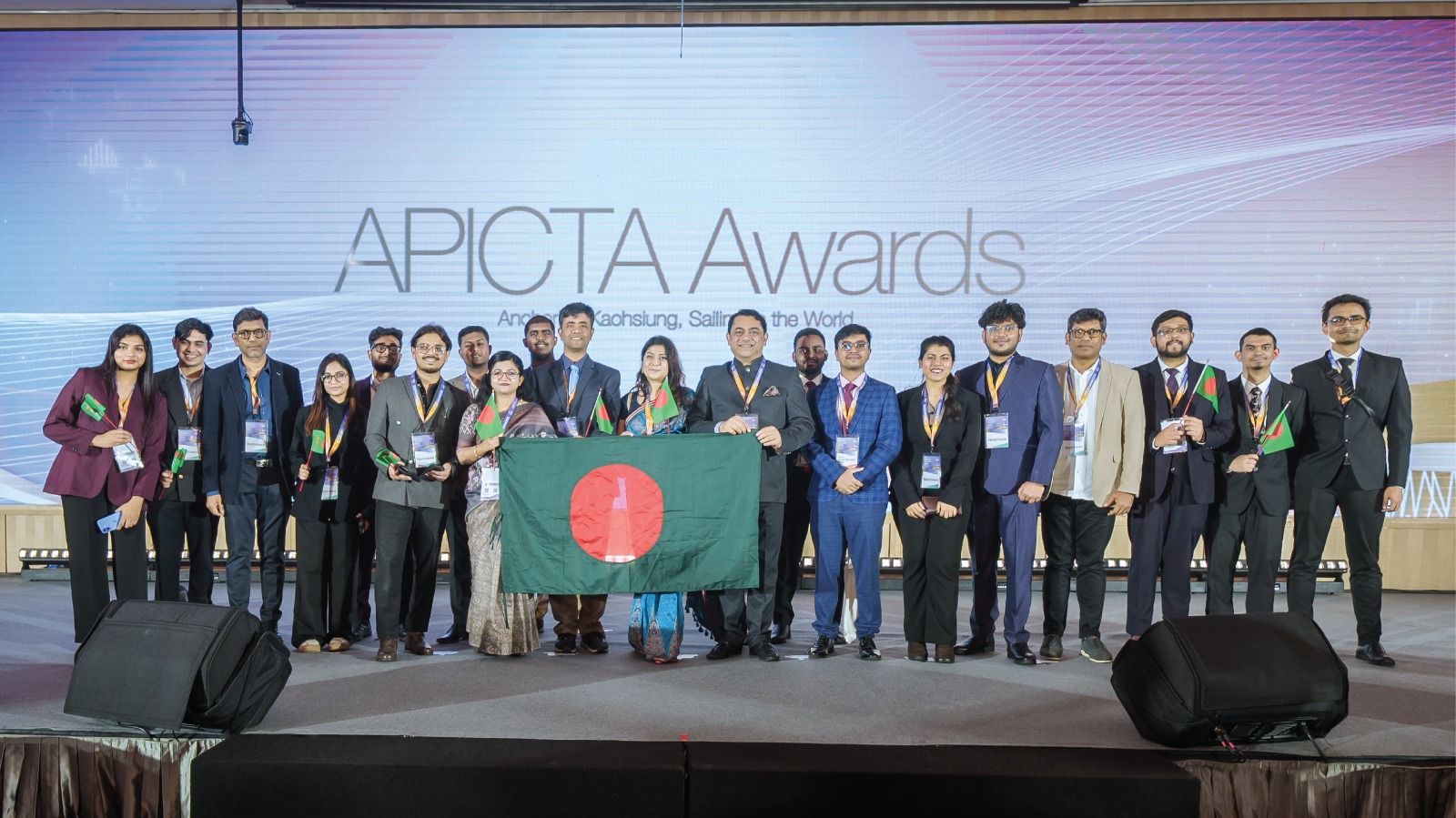
Bangladesh maintained a visible presence at the Asia Pacific ICT Alliance Awards (APICTA) 2025, one of the region’s highest-profile showcases for information and communications technology (ICT) innovation in the Asia-Pacific.
Bangladeshi entries secured recognition across multiple categories, reflecting what participants described as the sector’s steady progress.
Among the standout results, iXora Solutions Limited’s “Nyajjomullo (Fair Price)” and a student project, “SAFESTEP”, developed by students of Rajuk Uttara Model College, were named second runners-up in their respective divisions.
A third Bangladeshi project, “Radsafe”, developed by students at the Military Institute of Science and Technology (MIST), received a merit award, with the institute describing the system as an IoT- and machine learning-enabled solution for nuclear radiation safety.
The list of achievements linked to Bangladesh’s APICTA 2025 participation also included success in a separate international startup pitching event.
Fatima Ashraf, a MIST student and founder of Automated MTBAM, participated in National Yang Ming Chiao Tung University’s “MEGA DAY” startup pitch and won a silver prize, along with $5,000, according to the organizers' event coverage.
Bangladesh also recorded results in student-level competitions connected to the APICTA 2025 programme. Mohammad Mehran Islam Mahim, a student in the Electrical and Electronic Engineering department at North South University, won the Code Judge workshop competition, while Munem Shahriyar Islam Samanta, an architecture student at Bangladesh University of Engineering and Technology, finished as first runner-up.
APICTA 2025 was jointly hosted in Taiwan by the Asia Pacific ICT Alliance, Taiwan’s Ministry of Economic Affairs (MOEA), and the Taipei Computer Association (TCA).
According to the organisers, 256 projects from 12 member economies participated this year, competing across a broad range of categories that included communications, industrial applications, startups, and sustainable and environmentally friendly technologies.
Bangladesh submitted 20 projects to the competition, which were selected through the Bangladesh ICT & Innovation Awards 2025, organized by the Bangladesh ICT & Innovation Network (BIIN).
At the awards ceremony, Taiwan Vice President Hsiao Bi-khim said the awards were particularly significant for Taiwan as it sought to strengthen ties with ASEAN member states and South Asian countries, which she described as a large share of APICTA’s membership.
She urged participating organisations to help build Taiwan as a hub for innovation, research and startups, and said APICTA was a platform that generates new ideas, builds partnerships and encourages bold initiatives for the future.
Echoing those remarks, MOEA Deputy Minister Shen Jong-chin said this year’s categories reflected international technology trends, with particular emphasis on smart applications and software-hardware integration.
He added that the rapidly growing smart-technology markets across APICTA’s member economies offer opportunities for local and regional organisations to expand, and said the host economy’s strong performance underscored Taiwan’s position as a supplier of advanced ICT products and solutions.
Leading the Bangladeshi delegation, Syed Almas Kabir said Bangladesh’s regular participation was not only about awards, but also about learning, benchmarking and understanding its standing against global standards.
He also said that the maturity and relevance Bangladeshi projects now demonstrate before international judges point to the potential for larger achievements ahead. APICTA’s governance listings identify him as part of the organisation’s executive committee structure.
First held in 2001, the APICTA Awards are often described as the “Oscars” of the region’s tech industry, recognising creativity, innovation and excellence among entrepreneurs, organisations and students.
Bangladesh’s results at APICTA 2025 show that its ICT sector is moving to a new stage. Local companies and student teams are no longer just taking part; they are winning awards and earning recognition from international judges. Many of the projects focus on social problems, fairer markets, safety and sustainability, which shows that technology in Bangladesh is being used for both economic growth and positive social change.
If this momentum is supported by steady policy, more international exposure and closer cooperation between industry and universities, the country’s recent achievements may become the start of a stronger, long-term success story in the global technology arena.