Tech That Will Reshape Your Life in 2026

Staff Reporter
31 December 2025, 19:42
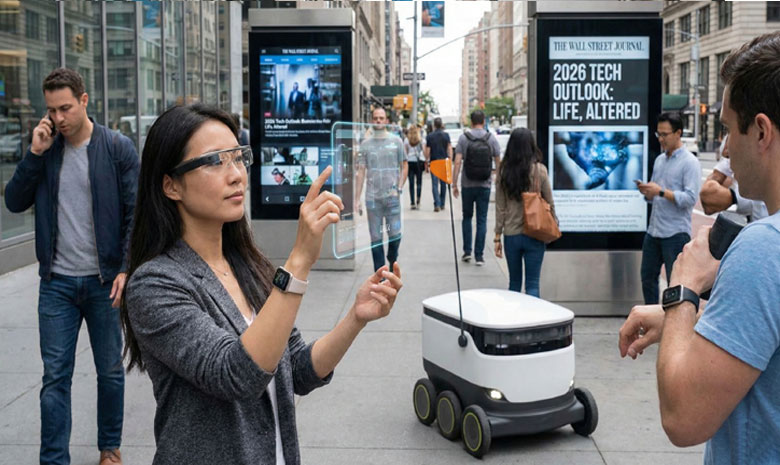
Technology in 2026 is set to feel less like a glimpse of the future and more like something impossible to avoid. The next wave of innovation is moving beyond convenience and entertainment into the core of how people live, work and make decisions.
From artificial intelligence woven into daily routines to robots quietly taking over repetitive tasks, The Wall Street Journal’s 2026 tech outlook points to a year of practical, life-altering change.
Unlike earlier waves that focused on faster devices or new platforms, the trends for 2026 centre on integration. AI is evolving into a thinking partner. Automation is moving into physical spaces. Digital systems are replacing long-standing habits. And as these tools grow more powerful, questions of trust, security and responsibility are becoming as significant as the technologies themselves.
For business owners, professionals and ordinary users alike, understanding these shifts is no longer optional. They will shape productivity, decision-making, privacy and quality of life—often quietly, in the background. The following are the key technologies expected to reshape everyday life in 2026.
Artificial intelligence as a daily co-pilot
In 2026, artificial intelligence is shifting from an occasional tool to a constant presence. Current trends point to AI becoming deeply embedded in everyday activities—organising information, prioritising work, drafting content and supporting real-time decisions. Rather than displacing human judgement, AI is being positioned as a co-pilot, augmenting how people think, plan and execute.
Voice assistants, predictive systems and AI-powered platforms are becoming more conversational, more aware of context and more proactive. At home and at work, AI is reducing friction and speeding up routine tasks, allowing people to focus on higher-value activities. The real shift is not simple automation, but collaboration between humans and machines, with AI handling complexity in the background.
Robots move beyond the factory floor
Robots, long concentrated in industrial settings, are now edging into homes and service environments. Advances in AI, sensors and lower costs are speeding their arrival in domestic and workplace roles far removed from traditional manufacturing. These are not humanoid machines, but task-specific devices designed to take on repetitive, time-consuming work.
Consumer robotics in 2026 is focused on practicality: cleaning, monitoring, delivery and basic assistance. As these systems become more reliable and affordable, they are starting to change how households and businesses think about labour, efficiency and time. Adoption will be gradual, but the emergence of robots outside factories marks a significant new phase in everyday automation.
Digital identity replaces wallets and passwords
By 2026, proving identity—online and increasingly offline—is undergoing a major shift. Digital identity technologies are rapidly supplanting physical wallets, usernames and passwords with secure, biometric-based verification. From facial recognition and fingerprints to government-backed digital IDs, verification is becoming faster to complete and harder to forge.
This transformation is driven by both convenience and security. Passwords are more vulnerable, fraud is increasingly sophisticated and users expect seamless access across services. Digital identity systems in 2026 are likely to underpin banking, travel, healthcare and online commerce, reducing friction while raising pressing questions over data ownership, privacy and centralised control.
Cybersecurity becomes AI versus AI
As AI grows more capable, cyber threats do too. Cybersecurity in 2026 is defined by speed, automation and scale, with artificial intelligence deployed on both sides. Cybercriminals are using AI to craft more convincing phishing attempts, automate hacking campaigns and exploit weaknesses faster than before.
In response, organisations and individuals are turning to AI-driven security tools that monitor behaviour, detect anomalies and act in real time. This AI-against-AI dynamic means protection is no longer a one-off setup but a continuous process. For businesses in particular, cybersecurity is becoming a core operational function rather than merely an IT concern.
Brain-computer interfaces edge into practice
Brain-computer interfaces (BCIs), once firmly in the realm of science fiction, are making cautious progress towards real-world use. In 2026 these technologies remain at an early stage, but advances in neural sensing, machine learning and wearable hardware are accelerating development, especially in medical and accessibility contexts.
From assisting patients to regain mobility to enabling hands-free control of devices, BCIs point to a potential shift in how humans interact with machines. Widespread consumer use is still years away, yet ethical, medical and social debates are already intensifying as thought-driven computing moves closer to practical reality.
Autonomous vehicles move beyond pilots
Self-driving technology is slowly leaving controlled trials and entering everyday operations. In 2026, autonomous vehicles are expected to expand from pilot schemes into delivery fleets, logistics chains and limited passenger services in more cities. Fully autonomous private cars remain a longer-term ambition, but incremental advances are already reshaping transport.
Improved AI perception, better mapping and clearer regulation are helping to drive this change. For businesses, autonomous vehicles promise gains in efficiency, safety and cost—especially in last-mile delivery and commercial transport. For consumers, they signal a gradual rethinking of how mobility is provided and experienced.
Satellite internet redraws connectivity
The race to connect the world is increasingly taking place in orbit. By 2026, satellite internet is becoming faster, more reliable and more competitive as multiple providers widen their coverage. This is particularly transformative for rural communities, remote workers and businesses that have long struggled with poor broadband.
As satellite networks mature, they are challenging traditional providers on price, speed and availability. For many users, space-based broadband is evolving from a backup option into a primary connection, expanding choice and redefining what “reliable internet” means in a digital-first economy.
Healthcare technology moves into the home
Healthcare is gradually shifting away from centralised facilities and into everyday environments. In 2026, home-based health technologies—including wearables, remote monitoring tools, AI-assisted diagnostics and virtual care platforms—are enabling people to play a more active role in managing their wellbeing.
These tools support earlier detection, continuous monitoring and more personalised care, often at lower cost. As health systems struggle with rising demand, home-focused technologies are becoming a vital extension of traditional services, blurring the line between patient and provider and changing how health decisions are made.
What 2026’s technologies mean for life and work
Taken together, these trends point to a deeper shift towards automation, integration and personalisation. AI is becoming a thinking partner. Robots are taking on physical tasks. Digital systems are replacing long-established habits. Technology is increasingly shaping decisions once made entirely by humans.
The significance of these changes is not only technical but cultural and strategic. For individuals and organisations, the question is less whether these shifts will arrive than how prepared they are to adapt. In 2026, advantage is likely to favour not those who adopt technology fastest, but those who adopt it most thoughtfully.
Source: The Wall Street Journal