Experts Urge Stronger AI Skills, Governance and Industry Collaboration

News Desk
14 June 2026, 10:57
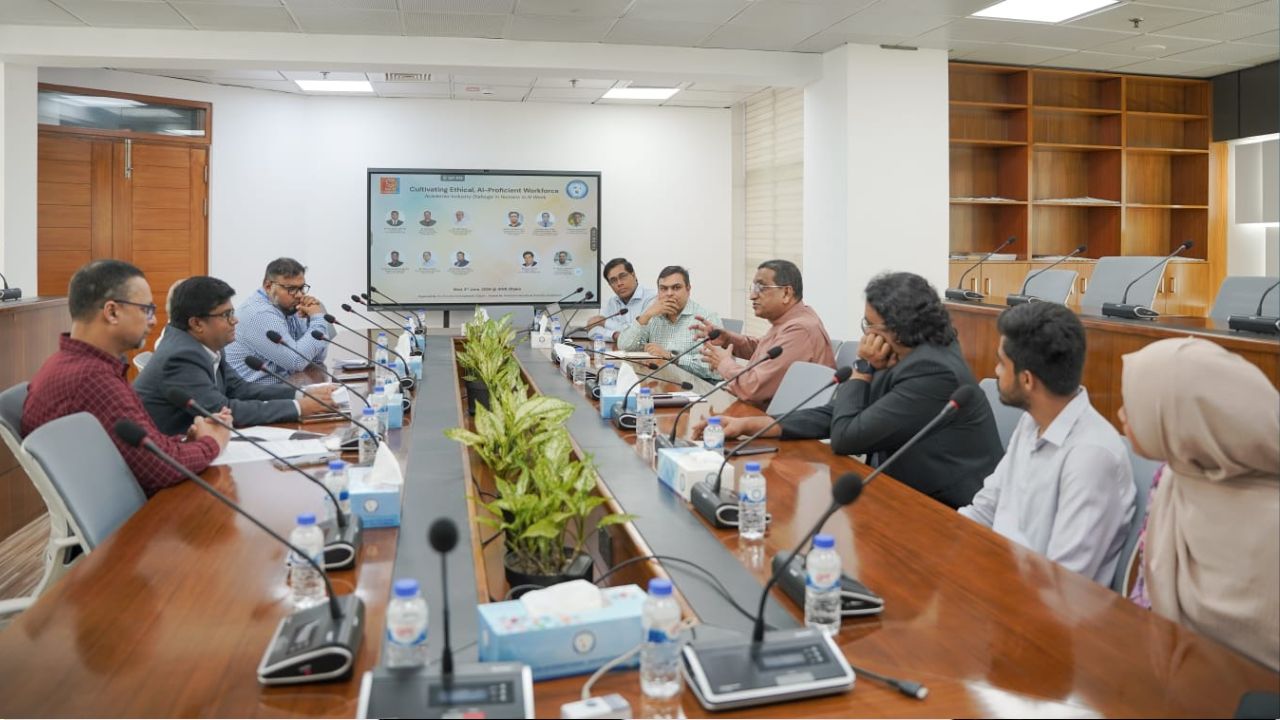
University academics, technology professionals, and industry leaders gathered in Dhaka on June 3 to discuss how Bangladesh can prepare its students and young professionals for a future increasingly shaped by artificial intelligence.
The roundtable, titled "Cultivating Ethical, AI-Proficient Workforce: Academia-Industry Dialogue," was organized by the AI Collective Bangladesh Chapter and hosted at American International University-Bangladesh as part of the global Humans in AI Week initiative.
Building Strong AI Foundations
The session was moderated by Muhammad Firoz Mridha, who emphasized the importance of strong fundamentals and practical AI exposure.
He encouraged students to use AI as a learning tool rather than a replacement for understanding. He also stressed the need to promote research, critical thinking, and responsible AI practices.
Access to AI Remains Uneven
Mohammed Asif said access to advanced AI technologies remains highly unequal around the world. He noted that only a small portion of the global population currently benefits from sophisticated AI tools, while many people have yet to meaningfully engage with the technology.
He also outlined the goals of the Humans in AI Week initiative and its importance in Bangladesh.
Data Protection and AI Governance
Major General Ibne Fazal Shayekhuzzaman warned that no technology is truly free.
He noted that users of free AI platforms often pay with their data and online behavior, which are collected and analyzed. He also called for strict AI policies and stronger data protection frameworks to govern the use of emerging technologies.
Universities Must Avoid AI Dependency
Dip Nandi said universities are actively redesigning curricula to include AI education.
However, he cautioned against making students overly dependent on AI tools. According to him, students must continue developing problem-solving abilities, independent thinking, and data skills. He also urged industry leaders to provide regular feedback to universities so graduates are better prepared for the job market.
Early AI Education and Human-Centered Design
Mahfuz Quaisar Apu encouraged students to specialize in specific AI fields and begin developing skills before university graduation.
Meanwhile, Tabin Hasan stressed the importance of human-centered AI. He argued that public trust in AI will increase when people can use it easily and experience practical benefits in daily life.
Teaching Responsible AI Usage
Mohammad Oli Ahad said AI still faces significant limitations despite its rapid progress.
He urged educators not to discourage children from using AI but instead to teach them how to use it ethically and responsibly. He also called for closer collaboration between academia and industry.
Similarly, Md. Saef Ullah Miah said many students still struggle to use AI effectively. He emphasized that asking the right questions and critically evaluating AI-generated responses are becoming essential skills in the AI era.
Human and AI Collaboration
In his closing remarks, Kh. Ehsanur Rahman said AI should be viewed as a human-centric enabler rather than a replacement for people.
He argued that the future should be defined by collaboration between humans and AI, not competition between the two.
The roundtable concluded with a shared view that Bangladesh has both the talent and the opportunity to build an AI-ready workforce. Participants agreed that achieving this goal will require ethical leadership, effective governance, and stronger collaboration among government, academia, industry, and civil society.
About The AI Collective Bangladesh Chapter
The AI Collective Bangladesh Chapter is part of a global network that promotes the ethical and responsible development of artificial intelligence. The chapter aims to bring together researchers, entrepreneurs, technology professionals, and civil society representatives to encourage a human-centric approach to AI and ensure that its benefits are shared broadly across society.